
Commentary
By Ilakkiah Chandran
Introduction
How we eat, communicate, interact, and live our daily lives is inevitably influenced by practices from around the world (1,2). Today, we live in an interconnected world, where actions, events, and decisions made in one country influence the realities in others. This reality can be attributed to globalization efforts introduced in the 20th century when the exchange of produce, services and cultures was first introduced (1). As a global society, we have benefitted from integrating practices, cultures, and efforts; however, increased globalization has also led to a shift towards universality where cultures are viewed as identical, and Western ideals from the Global North are imposed upon the Global South. Consider the CN Tower being duplicated in the Sahara Desert. This structure was not built to withstand the extreme temperatures in this region, resulting in its unavoidable demise. A similar result can be anticipated when we attempt to duplicate practices from one region of the world to another, as the physical and social environments, realities and resources are not identical. Despite this evident disconnect, universal policies, programming, and practices continue to be developed (1,3,4).
Global Mental Health is one such effort that employs a universal approach across global societies. International organizations are building and implementing Global Mental Health efforts to standardize and improve the research and practice of mental health services for the global population (5,6,7). More than 80% of the world’s population resides in the Global South; however, they only have access to 20% of available mental health resources, given the lack of appropriate resources and financial restrictions (7). Global Mental Health aims to create a universal solution to improve mental health experiences, focusing mainly on the Global South. However, mental health care should not be a one-size fits all solution. This article argues that the current approach to Global Mental Health is impractical given the diverse socio-cultural environments worldwide and the added burden it creates for the Global South. A new global approach to addressing mental health will be presented that prioritizes local efforts.
Socio-cultural and environmental influences on mental health
The unique socio-cultural environment within an individual’s community, including attitudes, traditions, and practices can significantly impact their experience with mental health (8). These environments vary worldwide, given the centuries of firmly rooted history that is specific to communities. Neverthelesss, Global Mental Health efforts fail to prioritize sociocultural relevance in developing universal strategies. A key example is the Diagnostic and Statistical Manual of Mental Disorders (DSM-5), a widely accepted resource that is frequently relied upon to understand, diagnose, and treat mental health disorders in the Global North (9). Despite the tool being described as culturally sensitive, researchers have unveiled that it fails to capture nuanced cultural differences and dismisses the experiences of marginalized groups within different cultures (8). For example, many researchers argue that Post-Traumatic Stress Disorder (PTSD) is a cultural construct from the Global North (10). Therefore, the criteria identified in the DSM-5 for PTSD reflect experiences common in the Global North and often neglect that trauma responses vary based on time, place and social experiences (11,12). This may impact how traumatic experiences of individuals in different cultures are interpreted and, in some cases, over-generalized to be PTSD (11). As a well-received resource, the DSM-5 will likely be employed in Global Mental Health efforts (13). Its ineffectiveness in accurately capturing sociocultural contexts in marginalized groups perpetuates challenges for those seeking treatment and support.

The DSM-5 also recommends treatments based on research from Global North that often does not reflect the unique needs of the Global South (14). Research describes that when individuals in the Global South experience mental health disorders, they often rely on support from family and friends (15). In contrast, in the Global North, most focus is on individuals seeking treatment and healing independently (14). Introducing an individualistic model in the Global South can deviate from existing and effective practices and maybe counterproductive (14).
Similarly, the development of Global Mental Health proposes that it will be well-received in the Global South when this has not been the case (13). For example, mental health programs established in India over the last few decades have often transformed into Malaria prevention and Family Planning sites given the most prominent needs of the community (16). Global Mental Health efforts homogenize experiences and fail to recognize critical differences within social environments. These efforts often emphasize that low- and middle-income countries (LMIC) experience a gap in mental healthcare but fail to recognize that there are barriers within LMIC countries that perpetuate this gap (16). For example, the lack of affordable mental health services, healthcare professionals trained in mental health and the limited availability of services in rural regions compared to urban regions impact the accessibility of services among citizens in the Global South (16,17).
Burden on the Global South
The current focus of Global Mental Health efforts on scaling up medical resources and reducing the treatment gap in the Global South may indirectly burden existing systems within these communities (15). Mental health efforts are not transferrable to different communities as treatments do not directly reflect contexts (15). To close this gap, global efforts will likely utilize Eurocentric expertise, which may lead to increased diagnoses of mental health disorders, treatment plans, and healthcare services and supports based on the expertise and efforts spearheaded by those not from the Global South (15,18). These approaches may be counterproductive in the Global South as the cross-cultural applicabilities of labelling mental health disorders and medicalizing trauma and stress are uncommon (11,12). In the long term, these efforts may continue to burden the Global South rather than support them. Introducing a strategy, policy, or program is insufficient to ensure sustainable practice. Funding, resources, and the continued evolution of such programs are required to ensure their effectiveness and sustainability. Without these considerations, mental health strategies will be short-lived solutions that do not address the root differences in mental health access in the Global South.
If not Global, then Local
It’s evident that the use of global mental health efforts often neglect the direct and diverse needs of communities; therefore, it’s the use of local strategies to promote mental health may be more effective (19). The Bapu Trust is an advocacy group that focuses on their direct community’s mental health needs based on the available finances and personnel (19). This trust focuses on creating psychologically sustainable communities and engaging local practices of social support to help reduce the psychological distress experienced by community members (19). Given that the stigma associated with mental health often prevents community members from accessing mental healthcare services, the Bapu Trust refrains from employing words such as diagnosis, mental health, and psychiatric treatment when supporting the community, which has led to increased participation in these activities and improved the community’s mental health (19). The Bapu Trust demonstrates that local efforts can significantly impact people’s mental health and well-being and can be used to support individuals with mental disturbances. Moreover, these efforts signify the importance of cultural sensitivity in approaching the needs of people with mental health disorders. In Pune, India, the Bapu Trust launched their Seher program, which focused on going into neighbourhoods and connecting with citizens to discuss stress experiences while discussing community social and emotional resources (19). A vital feature of this program is to refrain from using psychiatric terminology and classification systems developed in the Global North to ensure they are focused on the needs of the communities they work with directly (19).

Conclusion
Globalization has led to the perception that all challenges worldwide can be overcome through common approaches. However, critical differences within the global community make universal solutions impractical and ineffective. An interconnected global society does not mean that communities are identical to universal needs. Localized efforts can effectively work toward addressing longstanding problems by collaboratively working within communities to evaluate their needs and using practical strategies to improve mental health services in the Global South.
At a global level, improving resource allocation allows for the creation of new local programs tailored to the specific needs of individual communities. Similar to how architects have shifted from duplicating stuctures like the CN Tower and instead construct buildings that fit the needs of their spaces, mental health programs should be built with the direct needs of their community in mind.
Acknowledgements
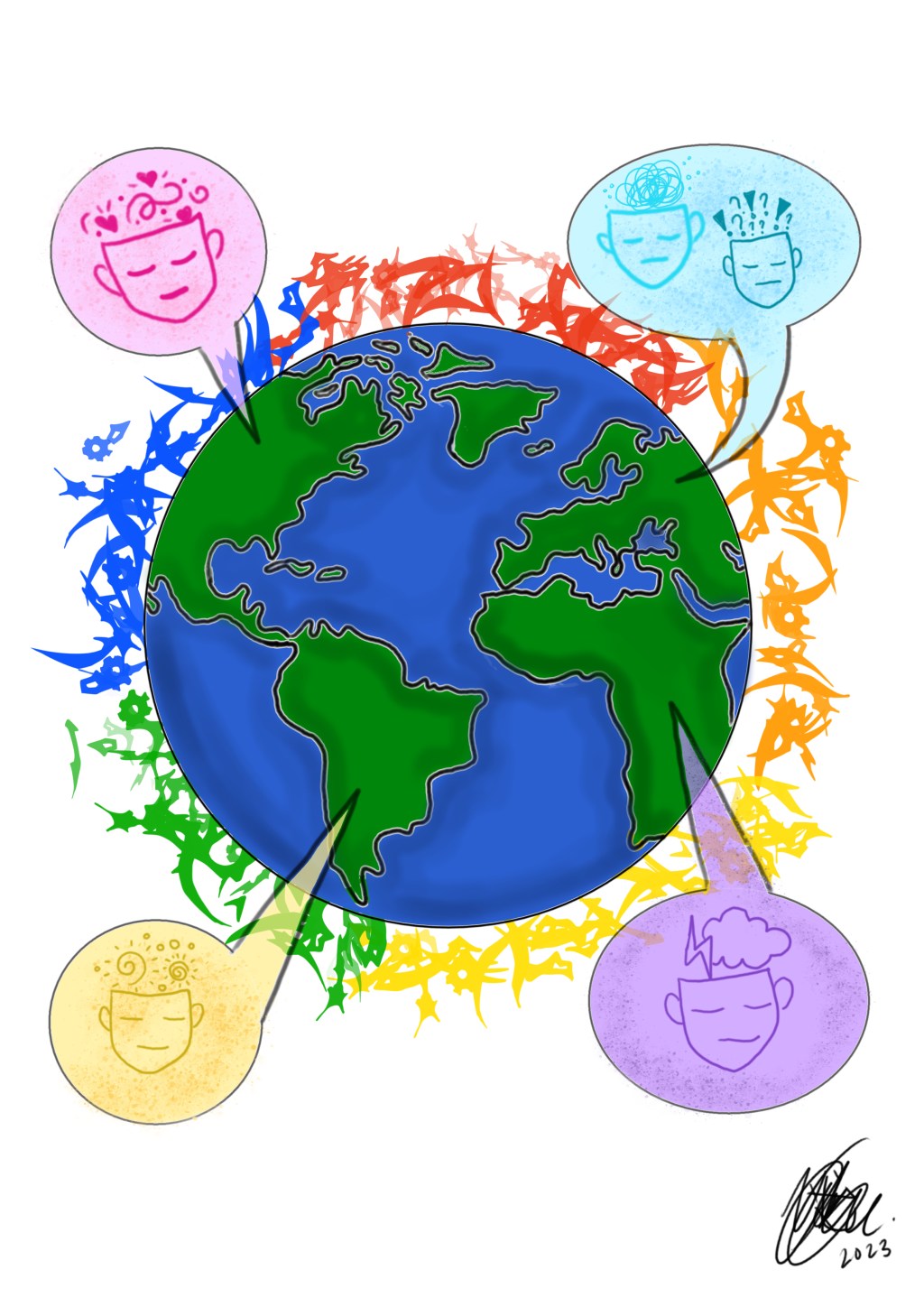
Featured illustration by Virginia Chiu for rehabINK.
To refer to this article, it can be cited as:
Chandran I. Interconnected, but not Identical: Challenges of Global Mental Health. rehabINK. 2023:Issue15. Available from: https://rehabinkmag.com
References
- Hartblay C. Disability and globalization [Internet]. 2019 [cited 2023 May 1]. Available from: https://www.academia.edu/38765088/Disability_and_Globalization
- Albrow M, Eade J, Washbourne N, Durrschmidt J. The impact of globalization on sociological concepts: Community, culture and milieu. Innovation: The European Journal of Social Science Research. 1994 Dec 1;7(4):371-89.
- Mackay H. The globalization of culture?. InA Globalizing World? 2004 Aug 2 (pp. 44-81). Routledge.
- Meekosha H, Soldatic K. Human Rights and the Global South: the case of disability. Third World Quarterly. 2011 Sep 1;32(8):1383-97.
- Onarheim KH, Rached DH. Searching for accountability: can the WHO global action plan for refugees and migrants deliver?. BMJ Global Health. 2020 Jun 1;5(6):e002095.
- Pan American Health Organization [Internet]. [cited 2023 May 13]. Available from: https://www.paho.org/en/topics/agenda-sustainable-development
- Patel V, Prince M. Global mental health: a new global health field comes of age. Jama. 2010 May 19;303(19):1976-7.
- Bredström A. Culture and context in mental health diagnosing: Scrutinizing the DSM-5 revision. Journal of Medical Humanities. 2019 Sep 15;40(3):347-63.
- American Psychiatric Association. Diagnostic and Statistical Manual of Mental Disorders. 5th ed. 2013.
- Jones E, Vermaas RH, McCartney H, et al. Flashbacks and post-traumatic stress disorder: the genesis of a 20th-century diagnosis. Br J Psychiatry 2003; 182: 158-163.
- Kleinman A, Kleinman J. Suffering and its professional transformation: toward an ethnography of interpersonal experience. Cult Med Psychiatry 1191; 15:275-301.
- Young A. The Harmony of Illusions: Inventing Post-Traumatic Stress Disorder. Princeton, NJ: Princeton University Press; 1995.
- Stein DJ, Reed GM. Global mental health and psychiatric nosology: DSM-5, ICD-11, and RDoC. Braz J Psychiatry. 2019 Jan-Feb;41(1):2. doi: 10.1590/1516-4446-2018-4101. Epub 2019 Jan 17. PMID: 30672968; PMCID: PMC6781713.
- Whitley R. Global mental health: concepts, conflicts and controversies. Epidemiology and Psychiatric Sciences. 2015 Aug;24(4):285-91.
- Mills C, Fernando S. Globalising mental health or pathologising the Global South? Mapping the ethics, theory and practice of global mental health. Disability and the Global South. 2014;1(2):188-202.
- Das A, Rao M. Misdiagnosis: Global Mental Health, Social Determinants of Health and Beyond (Chapter 4) – the movement for global mental health [Internet]. Amsterdam University Press; [cited 2023 May 13]. Available from: https://www.cambridge.org/core/books/movement-for-global-mental-health/misdiagnosis-global-mental-health-social-determinants-of-health-and-beyond/9FD59F5D24B58D394DEBE1AA7B9C2198 .
- Schierenbeck I, Johansson P, Andersson L, van Rooyen D. Barriers to accessing and receiving mental health care in Eastern Cape, South Africa. Health & Hum. Rts.. 2013;15:110.
- Rivera-Segarra E, Mascayano F, Alnasser L, van der Ven E, Martínez-Alés G, Durand-Arias S, Moro MF, Karam E, Hernández-Torres R, Alarcón S, Ramos-Pibernus A. Global mental health research and practice: a decolonial approach. The Lancet Psychiatry. 2022 Apr 7.
- Mills C, Davar B. A local critique of global mental health. Disability in the global South: The critical handbook. 2016:437-51.
 rehabINK | A world of rehabilitation research, practice, and advocacy