
Runqun Helen Zheng & Rebecca Renwick
rehabINK Art Piece Spotlight
Accessible Text:
The Pathways to Belonging (P2B) research project (Renwick et al., 2018-2024), was funded by the Social Sciences and Humanities Research Council of Canada (SSHRC). This research aimed to understand how young adults with intellectual and developmental disabilities (IDD) find belonging, and what pathways they take to do that. To address this aim, young adults aged 18–35 with IDD (young adults), as well as those who support them, including family members and service providers were interviewed to get their perspectives on and experiences with belonging and not belonging for young adults as well as how they find belonging. We will focus here on the interviews and main findings for the young adult participants because the comic book (Renwick et al., 2024) we are introducing was based on the main findings of the analysis of their interview data (Renwick et al., 2026).
Inclusive, participatory methods (Nind, 2019) were used to carry out the research. Specifically, young adults with IDD, family members, and service providers were engaged throughout the research as active members of the research team. Data collection with young adults took the form of two interviews with each participant, using methods from an inclusive, participatory toolkit that included visual (e.g., multimedia) and arts-based (e.g., mixed media) methods. Using methods from the toolkit, trained interviewers invited young adult participants to reflect on, discuss, and draw/create a map of the people, activities, and places that foster and support their experiences of belonging and finding belonging as well as those that do not.
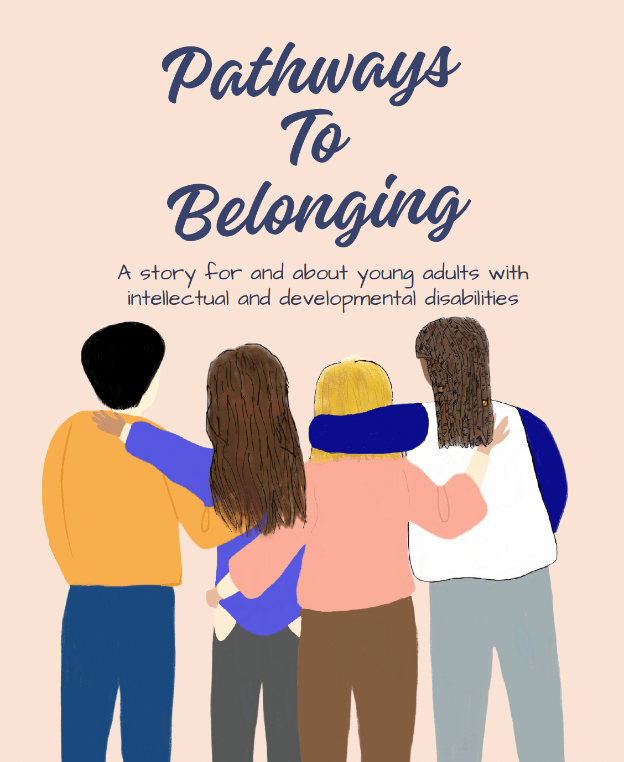
Knowledge translation of the findings of the research was done using several formats. One format was a short comic book presenting key themes from the findings of analysis of the data for the young adult participants in an accessible and inclusive format.
The cover of the comic which appears here, depicts four friends standing side by side with their arms around one another. Though they come from different backgrounds and have distinct stories, they look forward together, conveying togetherness and shared belonging. From left to right, the figures wear an orange sweater and blue jeans, a purple top with long brown hair, a soft pink hoodie, and a white henley top with blue sleeves. Their close embrace shows care and connection, with no one positioned at the margins.
The full comic is available at: http://pathwaystobelonging.ca/comic/, which includes both digital and print-friendly versions.
References
Nind, M. (2019). Thinking inclusively, acting inclusively, researching Inclusively. REACH: Journal of Inclusive Education in Ireland, 32(1), 2–10.
Renwick, R., Cameron, D., Ngo, M., Gabison, S., & Hingsberger, D. (2018-2024). Moving beyond inclusion: Pathways to belonging for young adults with intellectual and developmental disabilities. SHHRC Insight Grant #1497.
Renwick, R., Chowdhury,M.A., & Estrella, J. E. (2026). Moving beyond inclusion: A theoretical model of belonging pathways for disabled young adults (Article submitted and under review).
Renwick, R., Zheng, R.H., Routledge, F., Estrella, M.J., & Chowdhury, M. (2024). Pathways to belonging: A story for and about young adults with intellectual and developmental disabilities. [Comic book]. Pathways to Belonging Research Project, University of Toronto, Toronto ON.

