
Interview
By Andres Dorado Solarte
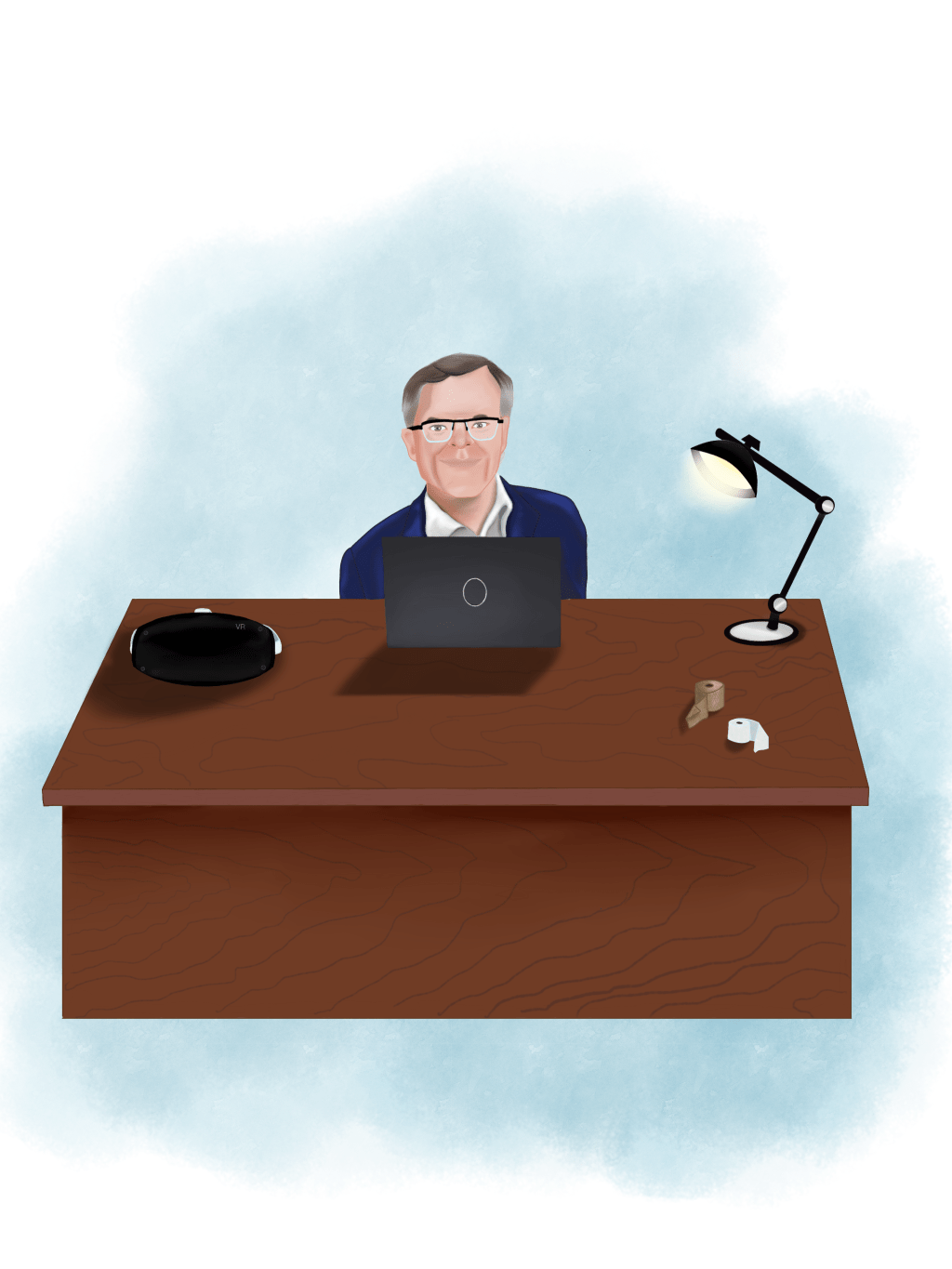
In the realm of rehabilitation medicine, where science meets the intricate tapestry of human biology and behavior, Dr. Martin Ferguson-Pell, a current professor in the University of Alberta’s faculty of rehabilitation medicine, stands as a trailblazer and innovator, weaving through the realms of physics, medicine, and the dynamic intersection of technology and healthcare. As his focus gravitated towards deep tissue injury rehabilitation, he discovered a unique complexity – bridging the physical impacts of new technologies (e.g., computer-simulated environments) with the intricate human responses, both physical and psychological, exhibited by his clients. This led Martin to embrace the challenge of navigating biological issues with technological innovation. He has developed virtual reality systems to simulate conditions felt by wheelchair users and leveraged advanced imaging systems to facilitate non-invasive detection of deep tissue injuries to foster a feeling of safety for the client, establishing a sense of trust with the client.

In the United Kingdom (U.K.), Martin noticed some “interesting and exciting opportunities to use a lot of the things that we [physicists] can do with sensor systems and analytics to advance healthcare.” Thus, he pursued a PhD in biomedical engineering from the University of Strathclyde in Glasgow, Scotland, where he witnessed the initial stages of forming a separate and unique field emerging from a handful of engineering projects. He found that applying the analytical and rigid measurement approaches of the physical sciences to the ambiguity of the problems in medicine was highly challenging, especially when he leaned more toward rehabilitation medicine. Martin noted that this complex combination of disciplines is a gratifying pursuit: “One of the things I’ve enjoyed in working in this field is dealing with that ambiguity in a way that is constructive, and responsive and responsible to the community that we’re working with.”
His global journey unfolded further as clinical and academic opportunities emerged in North America, working with the Glenrose Rehabilitation Hospital in Edmonton, Canada, and several institutions in New York City, U.S.A, such as Columbia University, the Rensselaer Polytechnic Institute, and the Helen Hayes Hospital – pivotal places where technology met clinical practice (e.g., developing modular wheelchair cushions for people with spinal cord injuries (1)). Driven by a passion for transforming the emerging field of assistive technology, he initiated a cultural shift, turning it into a clinician-led discipline, challenging the norms of engineering-led innovation. This shift in perspectives about what interdisciplinary collaboration looked like in rehabilitation medicine and developments in the field of assistive technology continued as he stepped into a brand-new, inaugural role, taking Martin across the Atlantic Ocean once again.
Serving as the endowed chair at the Institute of Orthopaedics at University College London, Martin played a pivotal role in developing a program that integrated orthopaedics and rehabilitation. His primary focus was on spinal cord injuries. Additionally, he assumed the position of research director for the hospital. During a radical transformation in the U.K.’s National Health Service (NHS), Martin witnessed the power of innovation in reshaping healthcare. The government’s modernization plan catapulted the NHS into a new era, embracing a culture of innovation and offering participation in clinical trials for every patient since there was substantial evidence that “every person who participates in a clinical trial does better than if they hadn’t participated in the clinical trial.” This period between 1999 and 2007 was characterized by Martin’s academic prowess and was a formative deep dive into the intricacies of healthcare management and politics.
In 2007, an opportunity beckoned from Edmonton, Canada, where he assumed the role of Dean of the Faculty of Rehabilitation Medicine at the University of Alberta until 2012. Between 2012 and 2018, Martin’s administrative journey at the University of Alberta continued, touching various facets of university leadership, including some time as Acting Provost and Vice President Academic, Founding Vice Principal of the Peter Lougheed Leadership College where he worked closely with former Prime Minister Kim Campbell, and as Senior Advisor to the President of the University. In 2018, Martin returned to the University of Alberta’s Faculty of Rehabilitation Medicine, continuing the development of the Rehabilitation Robotics Lab, which he described as “a sandbox for interdisciplinary work that relates to functioning quality of life for people through the use of technology.”
The essence of Martin’s work lies in bridging the gap between cutting-edge technology and its real-world impact, with a primary focus on three key areas: 1) wheelchair biomechanics; 2) using virtual and augmented reality applications to simulate training for rehabilitation professionals or to aid in the implementation of a particular rehabilitation intervention; and 3) virtual care which offers complex, virtual rehabilitation assessments to those in need, reducing the need for travel and associated collateral costs that often lead to financial inequities – whereby Martin expanded on these inequities with the following:

“Suddenly [clinicians] realize, they didn’t have to touch [the patients]. And that there are ways that actually doing a very reasonable assessment. That was an equivalent quality of outcome for the patient. And it meant that patients didn’t have to risk their lives travelling to see [a clinician] in the winter. Also, we discovered that (…) the average cost for a rural Alberta. the average is 450 [Canadian dollars] per clinic visit out of pocket in terms of travel cost. That’s the inequity Edmontonians complain about, spending 20 bucks parking in the parking lot of the University Hospital and rural Albertans spending 450, and that’s before counting other collateral costs like childcare, pet care. All of those other things that come in, we’re not even including those costs. So, I became quite passionate about the inequities that we were seeing (…) traveling around rural Alberta.”
Apart from his technical expertise, Martin’s approach to community engagement is characterized by humility and authentic connections, a vision embraced by his fellow lab members. Whether through open houses, social media, podcasts like Rehab Gab, or engaging with rural communities during golf tournaments, his rehabilitation robotics lab team strives to demystify the complexities of biomedical engineering and make his work accessible to all. Martin highlighted the role of listening and coming to the community with questions, not solutions. Martin spoke on a tendency that he and other researchers have when trying to problem solve with a community: “Especially in my field, what I want to do is, I want to go in there and show them. Look at this, don’t you think this is awesome? this black box of mine is such a magical thing. It’s gonna (sic) make everything better. That’s what I want to be able to do inside me, but I’ve got to discipline myself, not to do that.” Martin expressed holding back from “offering solutions from the outset” since such an approach can usually ignore the experiences of the client. Instead, Martin suggests returning to the fundamentals with the principles of the International Classification of Functioning (ICF), “working with the community and positioning a solution, so that the solution isn’t to address something that you’ve medicalized.” Martin proposes constructing a solution to address the barriers or limitations augmented by the environment in which they are living. Through these unconventional albeit compassionate approaches to creating connections, Martin hopes to “[lay] the groundwork for a long-standing substantial relationship with that community […] and unlock the ivory tower a little bit”.
Enhanced Learning Incorporating Extended Reality (ELIXR) Simulations, a not-for-profit initiative co-founded by Martin, also stands as a testament to his collaborative vision. Starting with a conversation with a colleague in a seafood restaurant, Martin laid out their vision – on a beer mat – of creating a virtual entity that would simulate educational content, clinical procedures, and media relations scenarios, benefiting both healthcare and post-secondary learning environments (e.g., virtual reality displays of anatomical models (2)). After some time of developing the concept and bringing together 11 post-secondary institutions on board with the program, ELIXR Simulations aims to propel virtual reality applications into mainstream healthcare and education, offering a space for students to “practice their [objective structured clinical examination] to reduce the stress and familiarize them with the process.” In objective structured clinical examinations (OSCE), students go through a series of stations to be assessed for different components of a clinical procedure and are typically examined by different observers at each station (3). For example, a student might be asked to document patient medical history in one station and interpret laboratory findings at another. Virtual OSCE simulations would help students understand the processes surrounding this objective, structured, and clinical examination.
In his extensive academic and clinical endeavors, Martin not only exemplifies the RehabINK objectives of knowledge translation and advocacy for accessibility to healthcare services but also contributes significantly to the field of rehabilitation science. His mentorship of young researchers in the Rehabilitation Robots laboratory aligns seamlessly with RehabINK’s mission “to inspire the rehabilitation science community through student-led, research-driven perspectives” (4). Through his diligent efforts, he has played an important role in advancing major progress within the realm of Canadian rehabilitation research. In the dynamic landscape of rehabilitation medicine, Martin continues to weave a narrative of innovation, empathy, and community-driven solutions. His journey exemplifies the fusion of scientific inquiry with the human touch, creating a legacy that transcends disciplines and transforms lives.
To refer to this article, it can be cited as:
Dorado Solarte, A. Transformation through Innovation: An Interview with Dr Martin Ferguson-Pell, PhD, CPhys, FRSA. rehabINK. 2024:Issue16. Available from: https://rehabinkmag.com
References
- Ferguson-Pell M, Van Cochran BG, Palmieri VR, Brunski JB. Development of a modular wheelchair cushion for spinal cord injured persons. Journal of rehabilitation research and development. 1986;23(3):63–76.
- U of A, Rehab Med: VR viewer gives students on-the-go virtual learning experience [Internet]. http://www.youtube.com. [cited 2024 Feb 7]. Available from: https://youtu.be/jUVfDl1Re1Q?si=Nz20Rs2fXUfUkUMU
- Harden RM, Stevenson M, Downie WW, Wilson GM. Assessment of clinical competence using objective structured examination. BMJ (Online). 1975;1(5955):447–51.
- ABOUT [Internet]. rehabINK | A world of rehabilitation research, practice, and advocacy. 2016 [cited 2024 Feb 7]. Available from: https://rehabinkmag.com/about/
 rehabINK | A world of rehabilitation research, practice, and advocacy